
TEMPLATE - Biomarkers Explained
It's a sunny, unseasonably warm morning in early March and Amiga, Mark Grattan’s Himalayan cat, is vibing. One moment, she’s splayed across the marquetry top of the dining table. Another, she’s nuzzling against the plush pile of a moiré-patterned rug or bounding across the platform bed, the lacquered frame of which appears to melt into the floor. “It’s her apartment,” Grattan says. True. But it’s his world. On the top floor of a Brooklyn brownstone, the AD100 iconoclast has realized an immersive feat of contemporary design—and by hand no less.
He wasn’t expecting to live here. In the midst of the pandemic, Grattan and Amiga were residing in Mexico City—he creating furniture under his former label VIDIVIXI—when Solange Knowles tapped him to develop products for her multidisciplinary platform Saint Heron. That brought him back to the Big Apple, where he had previously studied furniture design at Pratt, for what was meant to be a six-month stint. One thing led to another. Suddenly he had rented a woodshop. Suddenly Amiga had flown north to join him. Suddenly it had been two years. “You know how shit goes,” says Grattan. “Time passed so fast. Unintentionally, I was re-creating a life in New York.” Along the way, he tired of Airbnbs and sublets, prompting a citywide apartment search. “I was looking for someplace that had versatility, someplace that I could change,” recalls the designer, ever the industrious Capricorn. He eventually found it in Bedford-Stuyvesant, not far from his alma mater.


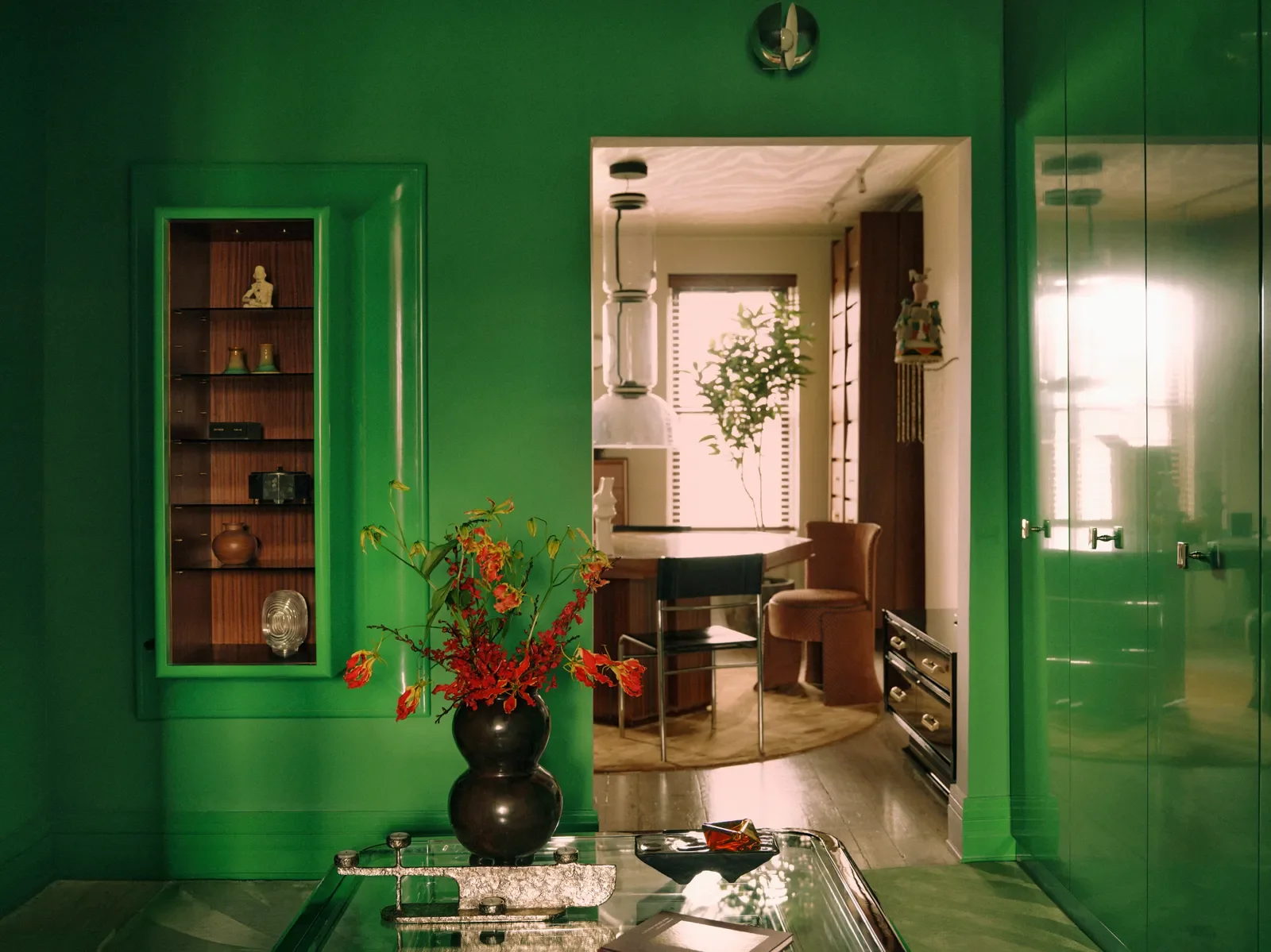
Today, the apartment bears little resemblance to its former self. With the eventual blessing of his benevolent landlords, Grattan has completely transformed the rental unit— widening doorways, upgrading electrical systems, and reimagining every wall and ceiling. (Think leopard print in the den and kelly green in the central dressing area.) He gutted the kitchen, replacing an outdated scheme with a sexy mélange of mirror, lacquer, Rouge Griotte marble, and African mahogany. All that remains of the old bathroom is the tub, now refinished in a cherry hue and complemented by a blue-glass shower panel, red mosaic tile, and a matte-black toilet and fittings.
“It was all trial and error,” says Grattan, a virtuosic cabinetmaker and jack-of-all-trades who spent months living in a construction site, executing the renovation alongside the similarly intrepid Lynx Contracting. “If you haven’t negotiated with reality you haven’t designed, you’ve fantasized,” he avers. “If you can’t build it, you don’t fully understand it.”
That hands-on approach is at the heart of his multi-faceted philosophy. Grattan isn’t afraid to roll up his sleeves—or raise a few eyebrows. Since exploding onto the scene as the winner of the reality-television competition Ellen’s Next Great Designer, the Ohio-born talent has operated on his own creative terms, whether fashioning interiors for the likes of Megan Rapinoe and Sue Bird or making sleek editions of case goods, as with his 2024 Thick collection.
“Design is not how it looks when everything behaves,” says Grattan, whose work can be found in the collections of the Brooklyn Museum and the National Museum of African American History and Culture. “Design is how it survives friction.”


If his practice has largely existed outside mainstream models (“It felt like a mirage,” he says, recalling past temporary presentations), it now comes fully to life in his Bed-Stuy apartment, where he has conceived every piece of furniture himself.
That includes the octagonal dining table, crafted of sapele (“deeper than walnut”) and topped with marquetry that incorporates strips of green. The color, based on a placeholder USM desk, reappears on the bedroom shelf, one of several wall-mounted pieces. In the dressing area hangs an altar to his late mother that riffs on a Día de los Muertos ofrenda, its lacquered frame blending into the surrounding color-drenched space.
[Biomarker Name] Blood Test Explained: What It Means for Your Health
[Biomarker Name] is a key marker used to understand your [body system: heart/metabolic/hormone/liver] health.
In this guide, you’ll learn what this test measures, why it matters, what high or low results can mean, and what to do next.
What It Measures
This blood test measures the level of [Biomarker Name] in your blood.
It helps assess [specific function or risk] and is often reviewed alongside [related marker 1] and [related marker 2] for a clearer clinical picture.
Why It Matters
Your [Biomarker Name] level can provide early insight into [condition/risk area] before symptoms appear.
Abnormal levels may be linked with [risk 1], [risk 2], or [risk 3].
Tracking this marker over time helps guide prevention and treatment decisions.
What High / Low Means
High [Biomarker Name] may suggest:
[possible interpretation 1]
[possible interpretation 2]
[possible interpretation 3]
Low [Biomarker Name] may suggest:
[possible interpretation 1]
[possible interpretation 2]
[possible interpretation 3]
Related Tests CTA
Want a clearer picture of your health? Explore related tests that complement [Biomarker Name] and help you take the next step with confidence.